Plaintext-first Movement – Why Developers Should Embrace the Purest Form of Text
There was a time when a simple tool like Notepad ruled the developer's world. This unassuming text editor by Microsoft, with its blank slate and lack of distractions, was the unsung hero of many technological triumphs. Whether it was opening files no other program could decipher, editing host files to circumvent licensing restrictions, or quickly jotting down notes, Notepad offered a purity unmatched by more complex tools.
Today, as developers are inundated with feature-rich editors, integrated development environments (IDEs), and proprietary formats, it's worth reminiscing about those Notepad days and asking ourselves: Why is plaintext so valuable?
This article took inspiration from a youtube video, The Unreasonable Effectiveness of Plain Text by No Boilerplate, a recommended watch.
Plaintext: The Developer's Bedrock
At its core, plaintext is the purest form of digital expression. It's unembellished, universal, and remarkably versatile. For developers, becoming comfortable with plaintext unlocks a world of productivity and flexibility that transcends the limitations of software or proprietary formats.
Here's why plaintext deserves to be a first-class citizen in your workflow:
Universality and Portability
Plaintext isn't bound by platforms, software versions, or proprietary ecosystems. A .txt file written decades ago is just as readable today as it was then. Whether you're on Windows, macOS, Linux, or even a mobile device, plaintext transcends technological barriers.
Imagine working on documentation in a proprietary word processor that gets discontinued. With plaintext, you never have to worry about compatibility or locked formats. It's the ultimate "future-proof" medium.
Productivity Through Simplicity
The simplicity of plaintext fosters focus. There are no fonts, styles, or formatting distractions. Just pure content. Tools like Obsidian have capitalized on this, turning plaintext into a powerful knowledge management system. By using Markdown, Obsidian proves that plaintext isn't inferior but a superior form of writing.
Markdown itself is a shining example of plaintext productivity. It allows you to write formatted documents in a human-readable syntax that is also easily convertible into rich formats like HTML or PDFs. This approach merges simplicity with functionality, enabling developers to create documentation, blogs, and even books without leaving the plaintext realm.
Plaintext as a Creative Tool
The influence of plaintext goes beyond writing, it's a medium for creativity. Developers use plaintext to build everything from simple sketches to complex systems.
Diagrams and Visualizations
Tools like Mermaid.js and PlantUML allow developers to create diagrams using plaintext syntax. For instance, a simple Mermaid.js flowchart might look like this:
sequenceDiagram
    John->>John: Generate a public and private key pair.
    John->>Bob: Hey Bob, this is my public key!
    John->>Bob: Please use it to encrypt our communication
    Bob->>Bob: Encrypts a message with John's public key.
    Bob->>John: [sends gibberish]
    John->>John: Decrypts Bob's message with his private key.
    John->>John: From Bob: Hey John, sure!
The resulting output is a visual diagram:
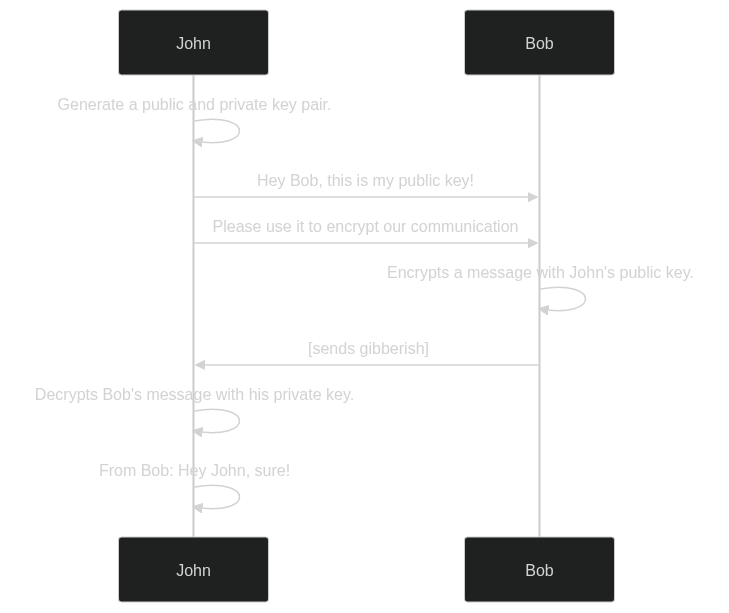
This plaintext-based approach eliminates the need for clunky GUI-based diagram tools, making updates and version control seamless.
Code as Plaintext
At its heart, programming itself is a plaintext endeavor. Every line of code is a testament to the power of plaintext, transforming human logic into functional systems that drive the modern world. From operating systems to web applications, plaintext has been the backbone of technological advancement.
The Power of Ownership
One of the most compelling reasons to adopt a plaintext-first approach is ownership. Unlike proprietary formats tied to specific tools or platforms, plaintext files belong to you and you alone.
- No Lock-In – When you write in plaintext, you're not beholden to any software. There's no risk of losing access to your work because of a subscription lapse or a discontinued product. Plaintext is universal and enduring.
- Version Control – Plaintext integrates seamlessly with version control systems like Git, allowing you to track changes, revert to previous states, and collaborate effectively. Try doing that with a binary or proprietary format, it's often impossible.
How Plaintext Transformed the World
Plaintext isn't just a tool for individual productivity, it has reshaped the world:
- The Internet Standards – Ever wonder how the internet standards were drafted and circulated? You guessed it, using plaintext. Even the very fabric of the internet is built on plaintext protocols like HTTP, SMTP, and DNS. There is no need for fancy Microsoft Word documents.
- Open Source Movement – Open-source projects thrive on plaintext. From code repositories to README files to licenses, plaintext enables collaboration and transparency.
- Knowledge Preservation – Important texts, from legal documents to scientific research, are increasingly being stored in plaintext formats like XML, ensuring they remain accessible for generations.
The Case for a Plaintext Movement
It's time to elevate plaintext from a tool to a philosophy, a movement that champions simplicity, ownership, and universality in a world increasingly dominated by proprietary complexity. A plaintext-first approach empowers developers to focus on content and logic rather than fighting with tools. It fosters a mindset of clarity and adaptability, essential traits in a rapidly evolving industry. By advocating for plaintext, we reduce dependency on proprietary formats and software. This promotes digital independence, ensuring that our work remains accessible and adaptable.
Perhaps the most compelling reason to adopt plaintext is that it's truly yours. Unlike flashy, feature-rich tools that may fade into obsolescence, plaintext is timeless. You can use it, version it, and adapt it however you see fit. The files you create in plaintext today will be just as accessible decades from now, free from the constraints of corporate whims or technological shifts.
Conclusion
Plaintext isn't just a relic of the past. It's a powerful, enduring tool for the future. From writing articles and creating diagrams to powering the internet and building software, plaintext offers unparalleled simplicity, universality, and ownership.
As developers, we should embrace plaintext not just as a tool but as a mindset, a commitment to clarity, efficiency, and independence. In a world that often prioritizes complexity for its own sake, plaintext is a reminder that sometimes, the simplest solutions are the most profound.
Let's make plaintext a movement.
29 Oct 2023 • methodology, writing, coding